
Technical Brief
From Open Data to Early Signals: Using AI to See Water Projects Before They Reach the Bid Phase

In infrastructure, timing defines the opportunity set. For AEC and consulting firms and treatment-technology providers, seeing a project early determines whether an opportunity can be shaped intelligently or merely pursued defensively. Too much of the market still waits for procurement portals to announce the future. By then, firms compete on price and compliance rather than fit and foresight — and the window to differentiate has already closed.
The decisions that shape how a project is defined, which technologies are considered viable, and which firms are seen as credible partners are made during the planning and budgeting stages — not at bid time. What remains at procurement is implementation, not influence. The real commercial question is not where projects are bidding today. It is where project intent is becoming visible before the market is crowded.
Seeing Owners Through Their Public Record
Project owners do not become visible only at procurement. Long before a bid is issued, they disclose future intent through capital improvement plans, master plans, rate cases, resilience studies, enforcement actions, funding applications, budget ordinances, and board materials. Each document may seem technical in isolation. Together, they reveal where capital is likely to move, on what timeline, and under which regulatory and financial pressures.
The signals that matter most include:
-
Capital improvement plans showing project prioritization and multi-year investment timelines
-
Rate case filings revealing the financial groundwork being laid for larger programs
-
Board agendas and minutes indicating whether a facility issue is urgent or deferred
-
Funding applications confirming a project has moved from concept to actionable initiative
-
Regulatory enforcement actions signaling compliance-driven capital pressure
For AEC and consulting firms, these signals identify where strategic dialogue is worth pursuing before a scope is fixed and before competitors are in the room. For treatment-technology firms, they pinpoint where specific problems — PFAS treatment, asset rehabilitation, disinfection compliance, non-revenue water — are becoming commercially salient before procurement language locks out alternative approaches.
The difference between a firm that reads these signals and one that does not is not just timing. It is the difference between shaping an opportunity and merely responding to one.
Early Intelligence Only Pays Off When Delivery Method Is in Play
Knowing early matters most when a project is heading toward alternative delivery — Design-Build, Progressive Design-Build, Construction Manager at Risk, or a public-private partnership. These methods require team formation, owner alignment, and technical positioning well before a solicitation is published. A firm that identifies a candidate project twelve months out under an alternative delivery model has a meaningful window to build relationships, shape scope, and position its approach. A firm that identifies the same project at RFP issuance is competing on price in a field that is already assembled.
Traditional Design-Bid-Build procurement compresses that advantage significantly. If a project is locked into a lowest-responsible-bid framework, early knowledge helps with scheduling and resource planning — but it rarely changes who wins. For AEC and consulting firms in the water sector, this is the critical distinction: early signals are commercially powerful primarily when the owner still has flexibility in how the project will be delivered.
This is why reading the public record for delivery method signals — not just project existence — is essential. Key indicators include:
-
WIFIA or EPA Water Infrastructure Finance and Innovation Act funding applications, which favor integrated delivery models
-
Capital plan language referencing accelerated schedules or bundled scopes
-
Board discussions about integrated project teams or owner capacity constraints
-
P3 feasibility studies or public-private arrangement references in master plans
For FirmoGraphs clients — the AEC and consulting firms and treatment-technology providers the platform is built for — identifying these projects early is what converts market intelligence into a genuine competitive advantage.
From Open-Data Exhaust to Market Intelligence
The challenge is not scarcity of information. It is abundance without structure. Public-sector owners publish thousands of documents annually — capital plans, rate filings, board packets, budget ordinances, grant applications — in inconsistent formats with uneven terminology. The difficulty is not whether signals exist. It is whether they can be discovered, normalized, and interpreted at scale across hundreds of owners and multiple document types.
This is where AI changes the economics of market visibility. Machine-driven methods sift large volumes of public material to surface patterns that would be prohibitively slow to detect manually. Repeated references to the same facility, shifts in capital-plan composition between planning cycles, or a cluster of signals around a compliance driver can indicate a project moving from possibility toward probability. Those same methods can flag alternative delivery language — accelerated timelines, bundled scopes, integrated team references — that signals a project where early positioning will carry commercial weight.
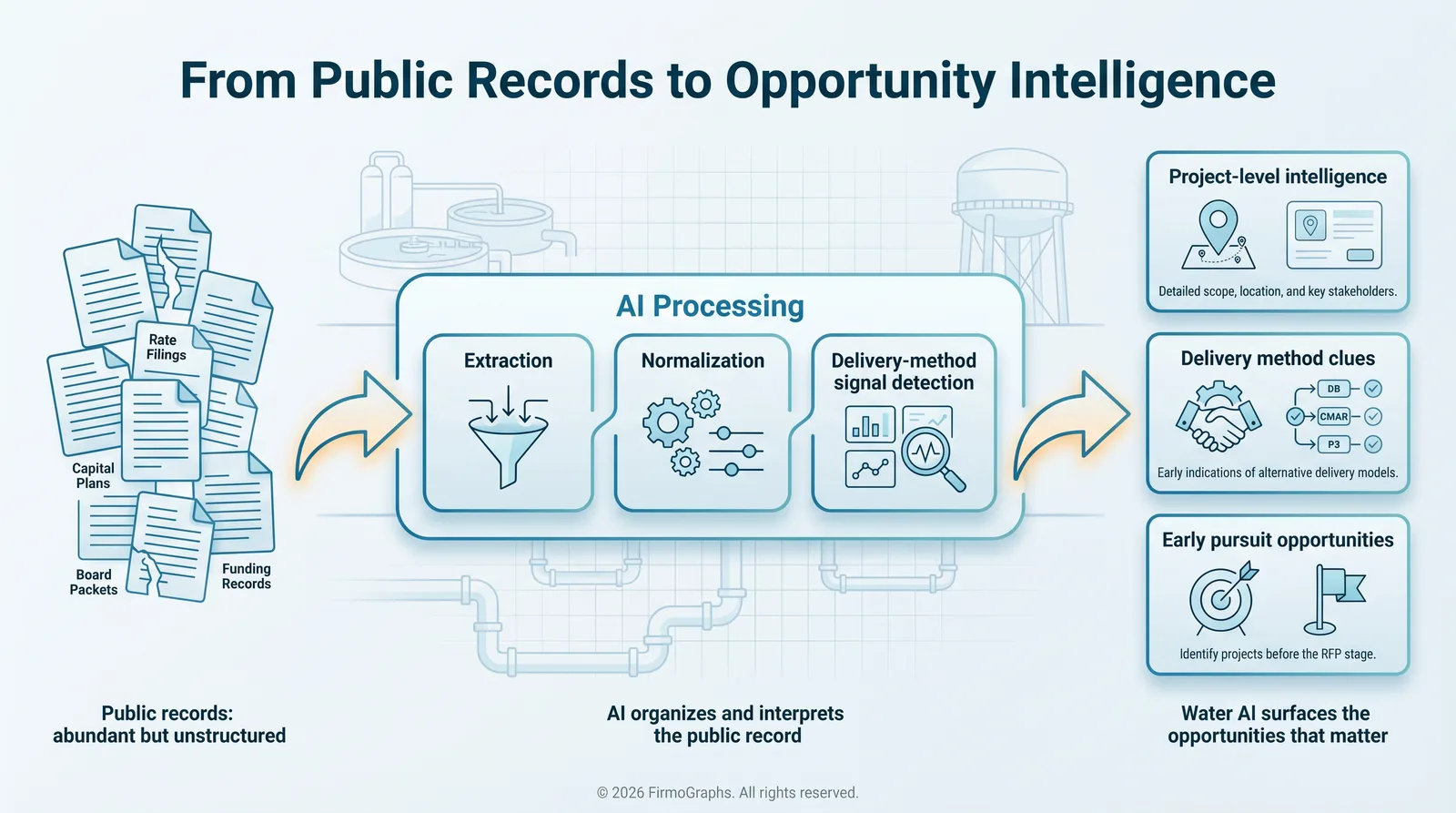
AI-assisted extraction also standardizes language across owners and geographies. What one owner calls plant rehabilitation another may describe as a treatment upgrade. Connecting those expressions into a consistent view of emerging need allows human expertise to supply the commercial interpretation — a design opportunity for an AEC or consulting firm, or a technology-selection window for a treatment-technology provider.
The objective is disciplined inference — reducing uncertainty by grounding market decisions in observable public evidence rather than anecdote or reactive pursuit behavior.
Why Earlier Visibility Matters Commercially
Early visibility improves not just timing but the quality of resource allocation. AEC and consulting firms and treatment-technology providers operate under real constraints: limited pursuit budgets, finite senior attention, and scarce technical specialists. When those resources deploy only after opportunities have formally surfaced, the result is a crowded funnel of low-probability pursuits where differentiation is minimal and pursuit costs are high.
Firms that engage before an RFP is posted typically face a fraction of the competition they encounter at bid time. They arrive with context — an understanding of how the owner has framed the problem, what constraints are shaping the options, and where their capabilities are most relevant. For treatment-technology firms, this window is often decisive: the most important commercial conversations happen while an owner is still evaluating categories of response, not after the preferred approach has been written into the tender documents.
For chief growth officers and business development leaders, the implication is direct. A market intelligence capability that surfaces the right opportunities — those heading toward alternative delivery — six to eighteen months before procurement reduces cost-per-pursuit, improves win rates on strategically aligned work, and frees senior technical staff from low-probability bids that were never a structural fit.
What Early Signals Look Like in Practice
Early signals accumulate across document types and time. A water treatment facility may first appear as a line item in a five-year capital improvement plan, then be referenced in a rate case filing as part of a planned investment package, then surface in a board agenda as a facilities condition assessment item, and finally appear in a state revolving fund application with a defined project cost and timeline. At each stage, the signal strengthens. By the time a formal solicitation is issued, the project has been publicly visible — in fragmented form — for years.
For AEC and consulting firms, that trajectory indicates where conceptual engagement or owner relationship-building may be timely — well before a scope is narrow enough to bid. For treatment-technology firms, it highlights where technology receptivity is increasing and where a demonstration project or early specification conversation may be welcomed before procurement documents narrow the field.
For firms that compete most effectively under Design-Build, Progressive Design-Build, or CMAR, the signal set extends beyond project existence. It includes the delivery method indicators described above — funding sources that favor integrated delivery, board discussions about accelerated schedules, and scope descriptions that suggest bundled or complex programs. Those are the signals that separate a project worth pursuing early from one where early knowledge offers little structural advantage.
This is the distinction between seeing projects and seeing signals. Seeing projects begins when the market is visible to everyone. Seeing signals begins when the market is still taking shape — when there is still room to influence how problems are framed, which solutions are considered, and which firms are seen as the right partners.
Where Water AI Fits
Water AI is built around this earlier view of the market. It monitors publicly available records across water infrastructure owners in the United States — capital plan changes, funding activity, regulatory pressure points, rate filings, and governance-level signals — and structures them into project-level intelligence that AEC and consulting firms and treatment-technology providers can act on before the bid phase begins.
For a treatment-technology firm, this means knowing which owners are approaching a PFAS compliance decision, a disinfection upgrade, or an asset rehabilitation cycle before the RFP is written and before specification language has been set. For an AEC or consulting firm, it means identifying where an owner is moving from planning toward design procurement under a delivery method where the team — not just the fee — determines who wins, and where alternative delivery indicators suggest that early engagement and teaming investment are worth making.
In long-cycle infrastructure markets, the firms that consistently perform best understood the opportunity earlier, recognized which projects were heading toward delivery methods where early engagement pays off, and positioned themselves when the market was still taking shape. Water AI exists to make that earlier, more selective engagement systematic — converting the public record into a structured, continuously updated view of where U.S. water infrastructure investment is heading and how it is likely to be delivered.